Is the demand to make RSS funding and assets public merely politics or a serious issue?
Saurabh Varshney
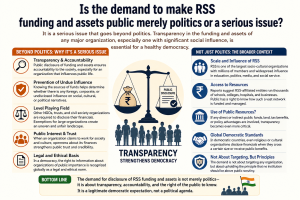
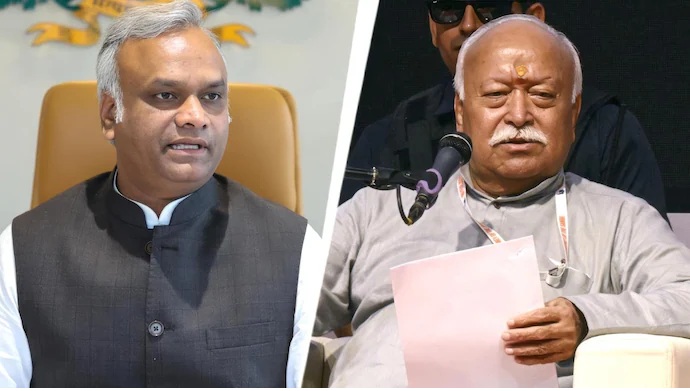
In India, the question regarding the transparency of organizations involved in public life arises from time to time. Recently, a demand made by Karnataka Home Minister Priyank Kharge—seeking public disclosure of the Rashtriya Swayamsevak Sangh’s (RSS) funding, income and expenditure, assets, and tax compliance—has sparked a new debate. The question is whether this is merely part of political accusations and counter-accusations, or a serious issue concerning transparency within a democratic system. In a democracy, transparency forms a crucial basis for the credibility of any institution. Political parties, non-governmental organizations (NGOs), religious bodies, and social organizations are expected to maintain a clear account of their financial sources and expenditures. If an organization exerts a significant influence on society and public policy, it is natural for questions to arise regarding its financial operations.
On the other hand, the RSS describes itself as a cultural and social organization, not a political party. The Sangh maintains that its activities are conducted based on the cooperation of volunteers and contributions received from society, and that it adheres to all legal compliance requirements. Supporters of the Sangh argue that singling out the RSS appears to be politically motivated, given that thousands of other social, religious, and ideological organizations are also active in the country. This is where the issue takes on a political hue. Since the RSS is widely regarded as the source of ideological inspiration for the Bharatiya Janata Party, questions regarding its financial affairs often become part of political discourse. The opposition frames this as a matter of accountability, whereas supporters view it as a consequence of ideological opposition. The reality is that the demand for transparency cannot be dismissed simply as politics. If an organization’s activities have a broad social and national impact, making information about its financial structure public can enhance public trust. However, this principle should apply equally not just to the RSS, but to all major social, religious, ideological, and political organizations. The problem in India is that demands for transparency often appear selective. When questions are raised only about organizations with opposing ideologies—and not about those aligned with one’s own—the impartiality of such demands comes under scrutiny. Therefore, it is essential to develop a uniform and universal standard for financial transparency that applies equally to all entities.
There is undoubtedly a political element to the demand for disclosing the RSS’s funding and assets, as it has been raised within a political context. Yet, the underlying issues of transparency and accountability are serious and significant for democracy. In a democracy, the credibility of any institution is determined not only by its actions but also by its transparency. Thus, the focus of the debate should not be on targeting a specific organization, but on ensuring equal accountability for all influential institutions. This is the true test of democratic values and good governance.
In a democracy, transparency and accountability strengthen the credibility of any major organization. When political parties, non-governmental organizations (NGOs), trusts, and companies are expected to make their financial details public, it is natural for a similar demand to arise regarding an organization of such immense influence. Supporters argue that if the Sangh were to disclose its sources of income, categories of donors, details of assets, and tax compliance information, public trust in it would increase further. On the other hand, the Sangh maintains that it considers itself a voluntary socio-cultural organization and complies with all legal requirements regarding the disclosure of information. Various trusts, service institutions, and educational organizations associated with the Sangh operate under distinct legal frameworks and submit the necessary financial details to the relevant government agencies.
The core issue of the dispute is not limited to the RSS alone. This applies broadly to all major social, religious, and ideological organizations that influence public life. The principle of transparency in a democracy dictates that major institutions serving the public interest should demonstrate greater openness regarding their financial and administrative affairs. Conversely, the principle of organizational autonomy holds that institutions should not be subjected to pressures beyond the scope of the law.
In this context, a balanced approach would be for the government to establish uniform transparency standards for all major social, religious, and ideological organizations. If an organization benefits from tax exemptions, public donations, or wields significant social influence, making its financial and administrative details public—at least to a minimum extent—can be considered consistent with democratic values. This debate is not about favoring or opposing any specific organization, but rather about strengthening democratic transparency, accountability, and institutional trust. Greater transparency fosters increased public trust and deepens the roots of democracy.
The author is a senior journalist, thinker, and political theorist.