A Champion of Nationalism, National Integration, and Democratic Values: Dr. Syama Prasad Mookerjee

A Special Article on the Death Anniversary of Dr. Syama Prasad Mookerjee:
Saurabh Varshney
It is a fact that certain great figures descend upon the earth for a time, perform monumental deeds for the world, and attain immortality; Dr. Syama Prasad Mookerjee—whose death anniversary falls today, June 23—was one such luminary. We remember Shri Mookerjee not merely for a single political event, but for his vast and significant contributions. His legacy was immortalized through the founding of the Bharatiya Jana Sangh. June 23 holds great significance in Indian politics and national life; it marks the death anniversary of Dr. Syama Prasad Mookerjee—a staunch nationalist thinker, educationist, independent India’s first Minister of Industry and Supply, and the founder of the Bharatiya Jana Sangh. Although he passed away under mysterious circumstances in 1953, his ideas, his struggles, and his dedication to national unity continue to inspire Indian politics and society to this day. Dr. Syama Prasad Mookerjee’s life exemplified the principle of placing the national interest above all else. At the age of just 33, he became the youngest Vice-Chancellor of the University of Calcutta. His contributions to the fields of education, culture, and nationalism were extraordinary. Following independence, he joined the country’s first Union Council of Ministers but deemed it appropriate to resign due to differences regarding issues of national interest—a testament to his principled nature. Dr. Mookerjee’s most significant political struggle was against the special status granted to Jammu and Kashmir. His famous slogan—”Two constitutions, two prime ministers, and two flags cannot coexist in one country”—reflects his vision of national unity. He believed that India’s sovereignty and integrity were paramount and that a separate constitutional arrangement for any state could not serve the national interest in the long run. A Legacy Immortalized by the Formation of the Bharatiya Jana Sangh
In 1951, he founded the Bharatiya Jana Sangh, which subsequently gave a new direction to Indian politics. The ideological roots of the present-day Bharatiya Janata Party can be traced back to the Bharatiya Jana Sangh. The traditions of organizational building, ideological clarity, and democratic struggle that he established remain influential in Indian politics to this day. While there have been occasional differences of opinion regarding Dr. Mookerjee’s views and policies, it is a hallmark of democracy that diverse ideologies present their perspectives, allowing the public to make decisions based on them. However, it is indisputable that he fearlessly articulated his stance on national issues and never shied away from taking political risks for the sake of principles. Today, as the nation faces numerous social, political, and global challenges, Dr. Syama Prasad Mookerjee’s death anniversary conveys the message that national interest, democratic values, ideological commitment, and ethics in public life must be accorded the highest priority. Politics is not merely a means to acquire power but a vehicle for public service and nation-building. Dr. Syama Prasad Mookerjee’s death anniversary is not just an occasion to pay tribute to a great leader but also a time for serious reflection on his ideals and ideas. His contributions toward national unity, cultural self-confidence, democratic values, and principled politics will always be remembered in Indian history. The nation is grateful to him, and future generations will continue to draw inspiration from his life.
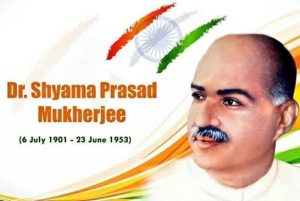
October 21, 1951, is considered a significant milestone in the history of Indian politics. It was on this day that the Bharatiya Jana Sangh was founded under the leadership of Dr. Syama Prasad Mookerjee. This was not merely the formation of a new political party but the beginning of a new chapter of ideological politics in independent India. Dr. Mookerjee was an ardent nationalist, an educationist, and a visionary statesman. When faced with ideological differences regarding the policies of the ruling establishment at the time, he chose to establish a new political alternative rather than compromise on his principles. The objective of the Bharatiya Jana Sangh was to conduct politics with nationalism, cultural identity, democratic values, and national unity at its core. Established on October 21, 1951, the Bharatiya Jana Sangh gradually carved out a strong identity for itself in the nation’s politics. Dr. Mukherjee conveyed a message of national integration by raising the slogan: “Two constitutions, two prime ministers, and two flags will not be tolerated in one country.” His struggle against the special status of Jammu and Kashmir is remembered to this day. Although he passed away in 1953, his ideas and political vision endured. The Jana Sangh later became part of the Janata Party in 1977 and evolved into the Bharatiya Janata Party in 1980. Dr. Mukherjee laid the foundation for the ideological current that exerts such a profound influence on the country’s politics today. Thus, it can be said that by founding the Bharatiya Jana Sangh on October 21, 1951, Dr. Syama Prasad Mukherjee gave Indian politics a lasting ideological direction and secured an enduring place in history. His life stands as an inspiring example of commitment to the national interest, adherence to principles, and public service.
“Two Constitutions, two Prime Ministers, and two flags will not be accepted in one country”:
The slogan “Two Constitutions, two Prime Ministers, and two flags will not be accepted in one country” was not merely a political catchphrase; it was a powerful proclamation of India’s unity, integrity, and constitutional equality. This declaration was made by the great Indian nationalist leader Dr. Mukherjee at a time when Jammu and Kashmir held a distinct status under special constitutional provisions. Today, on his death anniversary, this slogan is remembered as a significant chapter in the history of Indian politics and nationalism. Following independence, Jammu and Kashmir had a separate constitution, a separate flag, and a separate Prime Minister (*Wazir-e-Azam*). Dr. Mukherjee believed that this arrangement ran counter to the spirit of India’s national unity. He argued that if Jammu and Kashmir was an integral part of India, its citizens should enjoy the same constitutional framework applicable to other states in the country. Driven by this conviction, he entered Jammu and Kashmir in 1953. At that time, a permit was required to enter the state; opposing this requirement, Dr. Mukherjee decided to enter Jammu and Kashmir without a permit. He was arrested, and while in custody, he passed away on June 23, 1953, under mysterious circumstances. His death shook the entire nation and established him as a leader who made the ultimate sacrifice for national unity.
Dr. Mukherjee’s movement deeply influenced Indian politics. The Bharatiya Janata Party, which he helped found, kept this issue alive for a long time. Subsequently, this ideology remained a key pledge of the Bharatiya Janata Party. Many view the 2019 decision to abrogate Articles 370 and 35A as the fulfillment of Dr. Mukherjee’s dream. However, there have also been political differences of opinion on this matter. Some believed that the special status was essential to protect the unique circumstances and identity of Jammu and Kashmir. While diverse viewpoints must be respected in a democracy, it remains true that the issues of national unity and constitutional equality will always hold paramount importance. As India moves forward today to strengthen the vision of ‘Ek Bharat, Shreshtha Bharat’ (One India, Great India), Dr. Syama Prasad Mookerjee’s slogan appears even more relevant. It is not merely a political idea but a symbol of commitment to national unity, equal rights, and integrity. Dr. Mookerjee’s life conveys the message that it is the duty of every citizen to uphold democratic values and the constitutional order while placing the national interest above all else. The best way to pay tribute to him on his death anniversary is to resolve to further strengthen India’s unity, integrity, and democratic ideals.
The author is a senior journalist, thinker, and political analyst.